



Developments in the fund market can affect the real economy through various channels. In addition to firms’ inability to access their investments in the affected funds and the spillovers to their supply networks, declines in financial asset prices, tightening financial conditions, and weaker confidence may also influence spending, investment, and financing decisions of firms and households. Monitoring these channels is crucial for assessing the effectiveness of monetary transmission mechanism and risks to financial stability. In this blog post, we focus on one of these channels by examining firms with investments in funds placed under liquidation following the Capital Markets Board’s (CMB) decision of September 17, 2026. We assess these firms' exposure to the affected funds, their share in the economy, and their supplier linkages, and examine their credit utilization following the liquidation decision.
Size and Distribution of Fund Investments
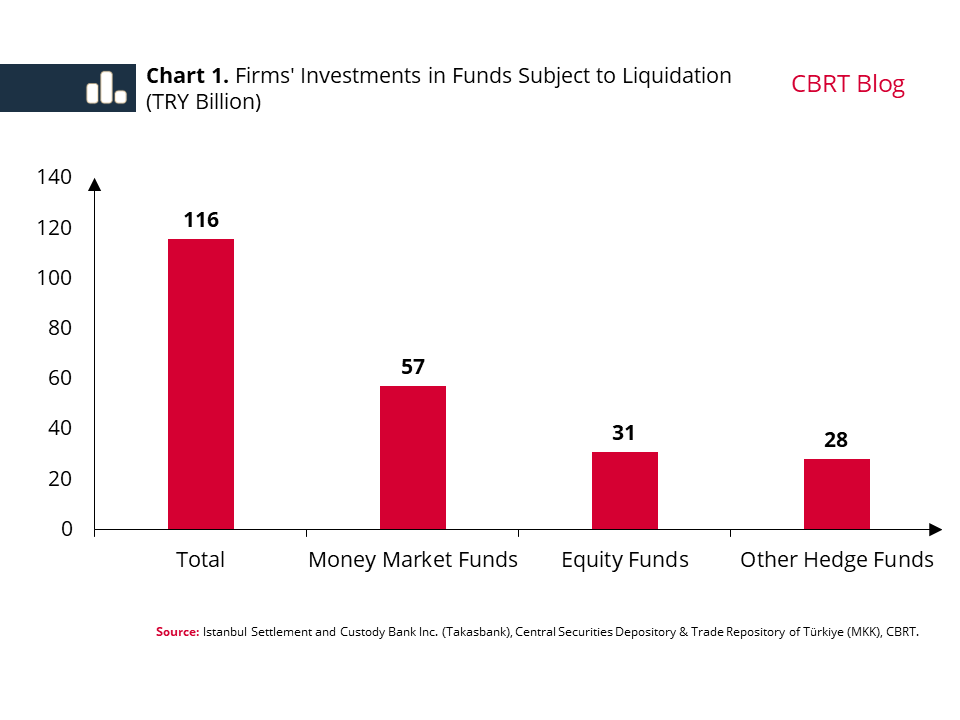
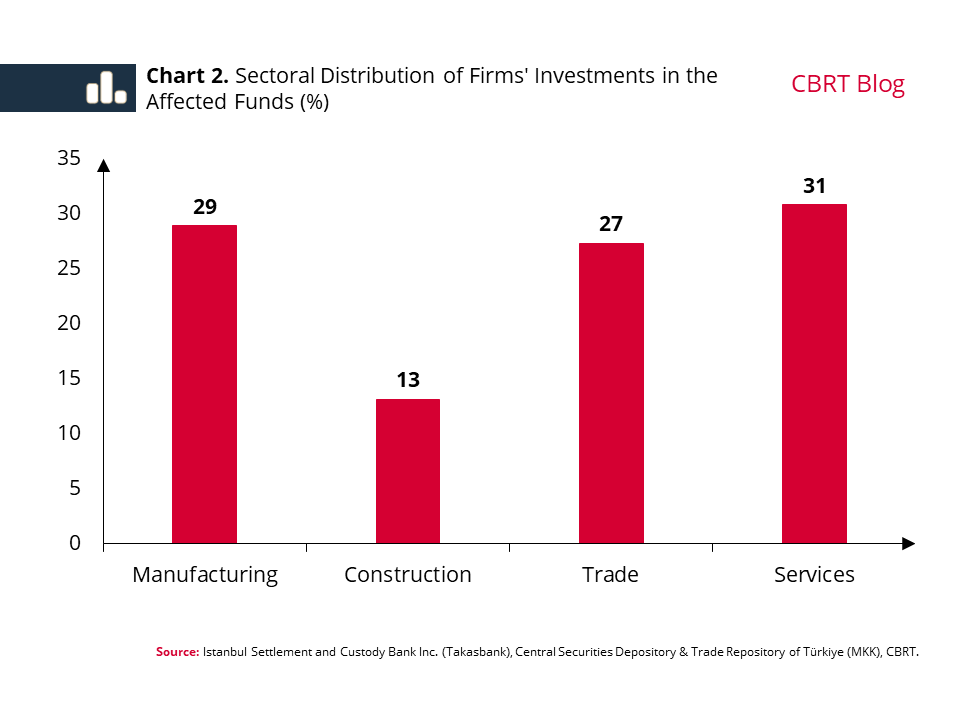
We begin by examining the distribution of firms’ investments in the affected funds. As of September 15, 2026, approximately 3,000 real sector firms held a combined TRY 116 billion in funds that are now being wound up.[1] Almost half of this amount, i.e. TRY 57 billion, was invested in money market funds, with the remainder held in equity funds and other types of funds (Chart 1). The sectoral distribution of these firms shows no significant concentration in any particular sector (Chart 2).
Economic Significance
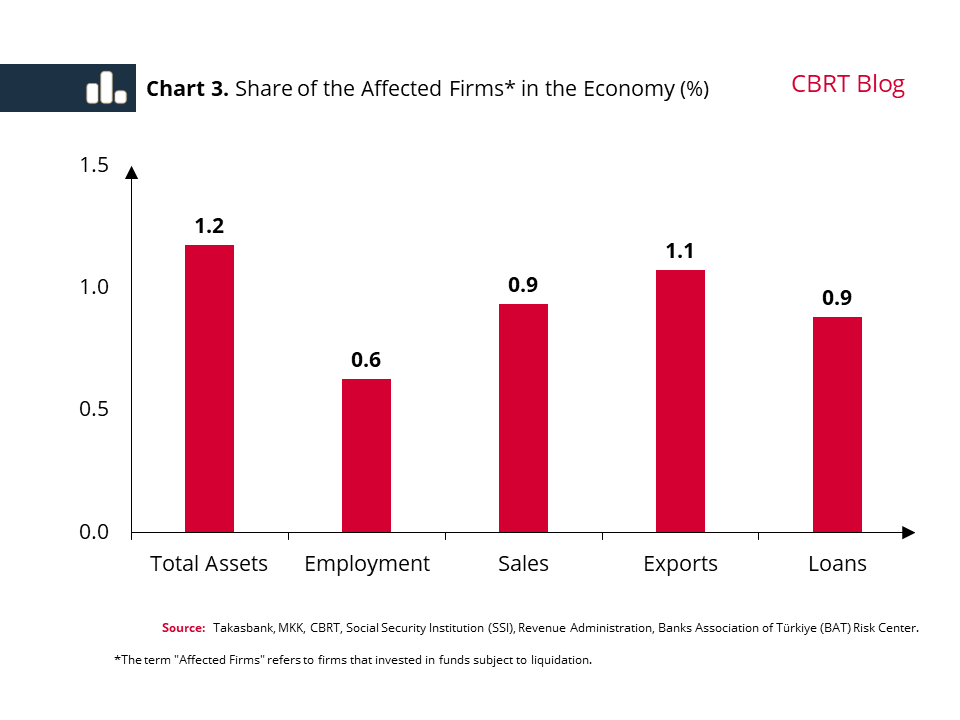
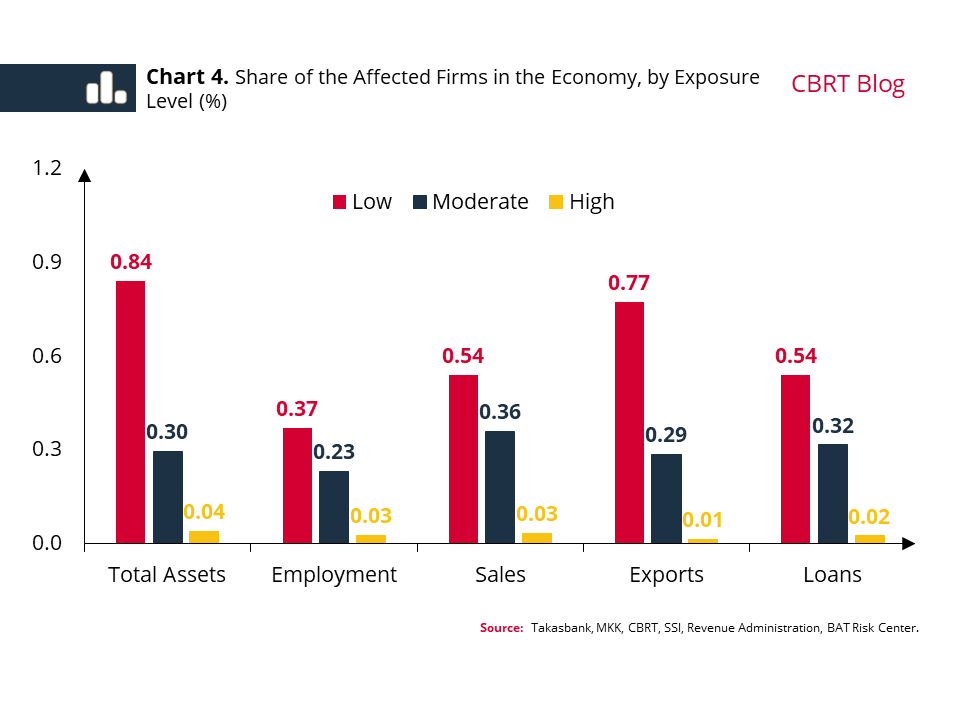
How significant are these firms in the broader economy? The affected firms account for approximately 1.2% of the real sector’s total assets, 0.6% of employment, 0.9% of turnover, 1.1% of exports and 0.9% of outstanding commercial loans (Chart 3).[2] However, the importance of their fund investments varies from firm to firm, particularly in terms of short-term risks. To capture this variation, we calculate an exposure ratio for each firm by dividing the amount invested in the affected funds by the current assets reported on its most recent balance sheet. We then classify the firms into three groups based on this ratio.[3] Firms in the high-exposure group account for 0.03% of employment and turnover (Chart 4). In other words, firms with high exposure to the affected funds account for a relatively small share of the economy. What is more, their share in total commercial loans is quite low at 0.02%.
Potential Spillovers Through Suppliers
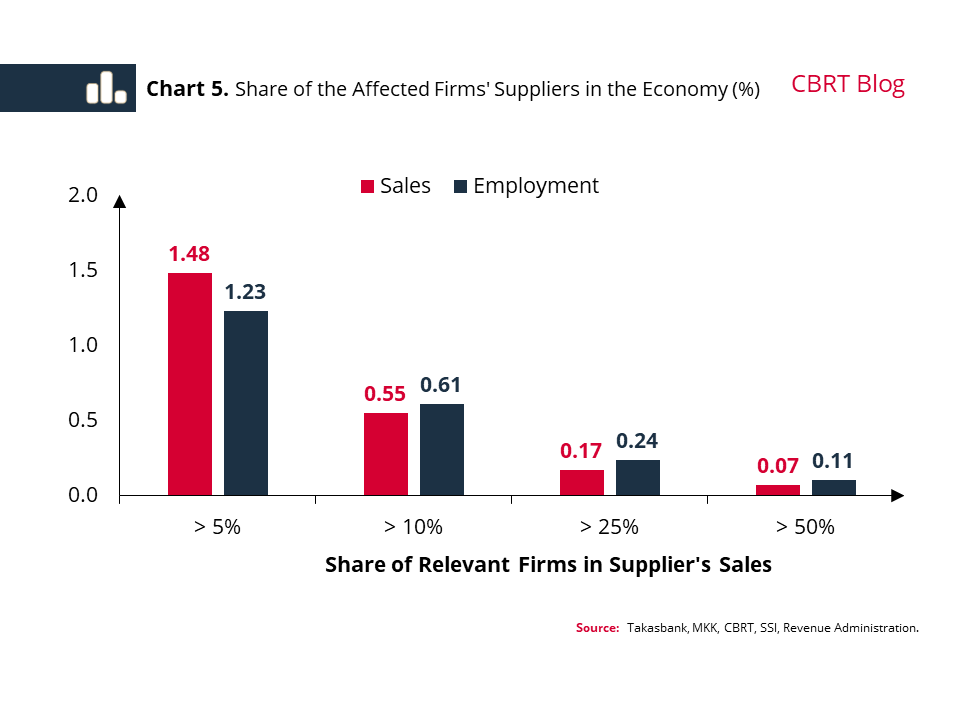
Next, we examine the firms’ trade linkages. A firm’s economic significance extends beyond its own operations: changes in financing or liquidity conditions can also affect other firms through trade links. We therefore use firm-to-firm trade data to identify suppliers that sell to firms with investments in the affected funds. Suppliers that depend on affected firms for more than 5% of their total sales represent 1.2% of total employment and 1.5% of turnover in the economy (Chart 5). When firms with lower exposure are excluded, these ratios fall considerably.
Access to Credit
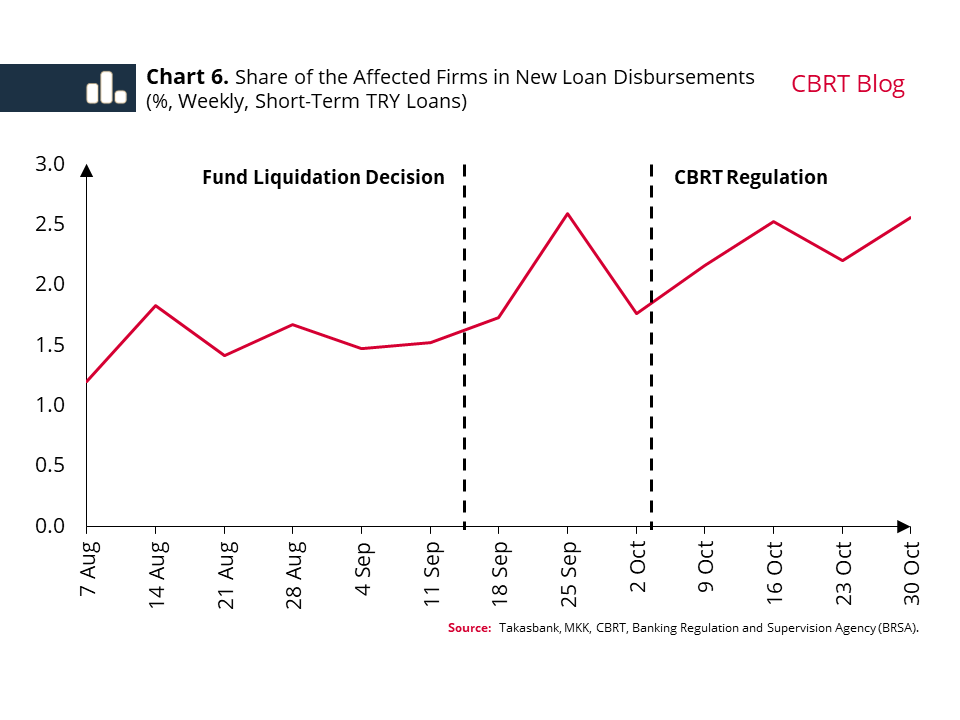
Finally, we examine access to credit among firms with investments in funds put into liquidation. Difficulties in covering particularly short-term liabilities during the liquidation process could increase these firms’ working capital needs. Access to credit is therefore important both for the firms and for wider financial stability. Weekly data show that the share of short-term Turkish lira loans extended to these firms in the total of such lending has increased (Chart 6).[4] In other words, the firms that invested in the affected funds still have access to credit. We assess that the Central Bank of the Republic of Türkiye’s (CBRT) macroprudential policy actions on October 1, 2026 to support macrofinancial stability and banks’ liquidity management have also contributed to this development.
In sum, our analysis sheds light on the economic significance of firms that invested in funds subject to extraordinary liquidation and their suppliers. However, these findings neither diminish the significance of the liquidity setbacks experienced by these firms nor provide a conclusion about the overall impact of developments in the fund market on the real economy. Declining asset prices, tighter financial conditions, and weaker confidence may also affect consumption, investment, and production decisions.
The CBRT's measures to support banks' liquidity management, along with regulations aimed at facilitating access to finance for SMEs and corporate bond issuers, may help contain potential risks. Meanwhile, further progress in the liquidation process could also help mitigate these effects.
[1] The analysis covers firms with investment balances of at least TRY 1 million as of September 15, 2026 in the funds subject to liquidation. Including investments below this threshold brings the total investment amount to TRY 116.2 billion and the number of firms about to 4,500.
[2] These firms’ investments in funds subject to liquidation amount to approximately 0.09% of the real sector’s total assets. Data for end-2025 are used for total assets and the latest available data for the other indicators. Employment data cover only employees registered under category 4A (under an employment contract) pursuant to Law No. 5510 on Social Insurance and Universal Health Insurance.
[3] Low exposure is defined as a ratio of 10% or less, medium exposure as a ratio above 10% and up to 50%, and high exposure as a ratio above 50%.
[4] Although these firms incur slightly higher average cost of credit than other firms, we estimate that this difference is not statistically significant.