





We had introduced the foreign exchange (FX) conversion support scheme in January 2023 to encourage firms to convert FX earnings from abroad into Turkish lira and to strengthen the CBRT reserves.[1] We initially offered support equal to 2% of the Turkish lira equivalent of the FX converted. In May 2025, we temporarily[2] increased this rate to 3%. With the regulation (in Turkish) we introduced in August 2026, the support scheme will become more inclusive and based on value added. In this blog post, we examine the content of this regulation and its potential implications.
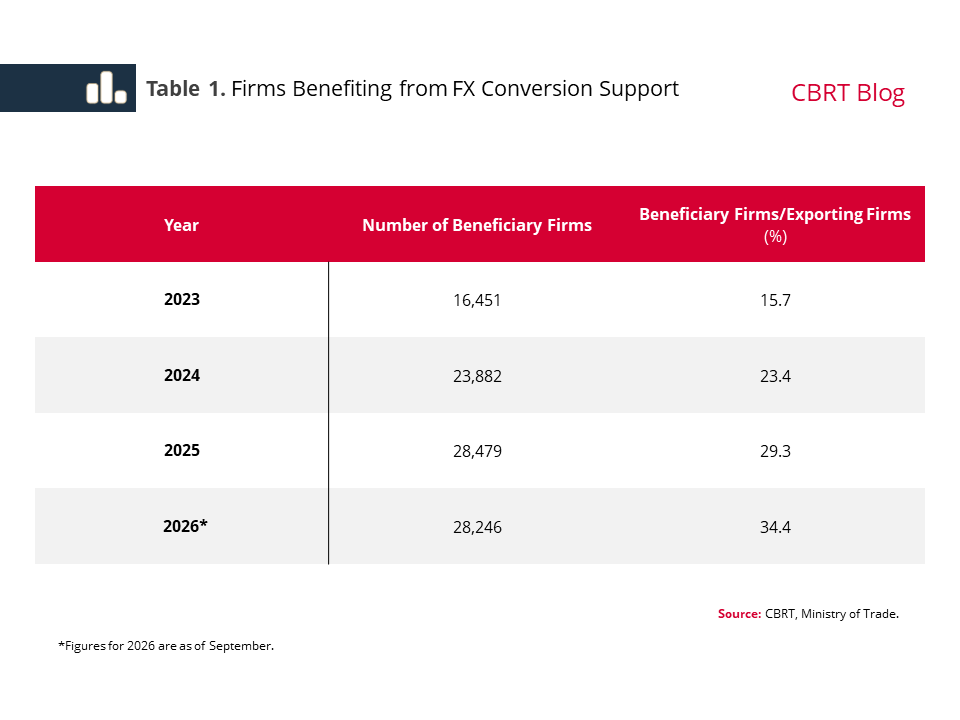
Since the scheme's launch in 2023, we have provided FX conversion support to approximately 44,000 firms. The share of exporting firms benefiting from the support scheme in all exporting firms has increased over time, reaching 34% in 2026 (Table 1). We expect this share to rise further under the new framework.
The changes set to take effect on October 1, 2026 under the new regulation can be grouped into three categories:
- We are removing the commitment not to purchase FX and introducing an FX position ratio requirement instead. Under the current framework, firms commit not to purchase FX for one month to receive support. In the new framework, to qualify for the support, the ratio of liquid FX assets to the higher of net sales revenue or total assets (i.e., the FX position ratio)[3] should not exceed 10%.
- We are linking the amount of export proceeds eligible for FX conversion support to firms' value added. We are limiting the amount of FX export proceeds that a firm can sell under the scheme within a year to the value added it generates. We calculate value added as the sum of the firm's annual operating profit and labor costs.[4]

- We are facilitating access to FX conversion support for suppliers producing goods for export. Thus, we expect more supplier firms that are not direct exporters to benefit from the support scheme. Accordingly, the support payment for the FX conversion carried out by an intermediary exporter on behalf of the supplier will be made directly to the supplier.[5]
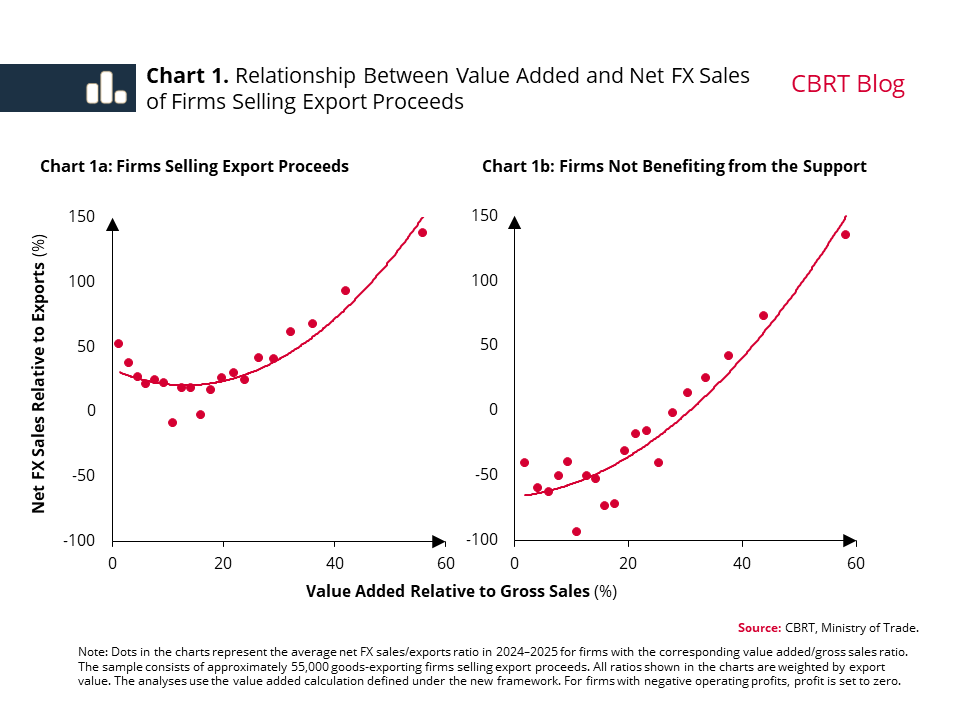
We aim to make the scheme's contribution to the CBRT reserves more lasting by linking FX conversion support to value added. Under the new regulation high value added firms, which have not yet benefited from the FX conversion support because of the commitment not to purchase FX, will also be eligible for the support. Indeed, our firm-level analyses indicate that the net FX sales/exports ratio is higher, particularly among firms with a high value added/gross sales ratio (Chart 1a). This relationship is more evident among firms that did not benefit from FX conversion support in 2024 and 2025 (Chart 1b). Taken together, in the new framework, we expect the FX conversion support to be directed towards high value added firms that are more likely to convert a larger share of their export proceeds into Turkish lira. Thus, we project that a larger share of FX sales under the support scheme will translate into net FX sales, thereby making a more lasting contribution to the CBRT FX reserves.
We are expanding the scheme to cover not only exporting firms but also those producing goods for export. In the current framework, although intermediary exporters can benefit from the support both for themselves or on behalf of their supplier, they mostly prefer to receive the support themselves. Under the new framework, by introducing firm-level value added limits, intermediary exporters will be able to convert FX proceeds on behalf of their supplier firm after exhausting their limits, and the FX conversion support will be directly transferred to the supplier's account.
In sum, with the new framework taking effect on October 1, 2026, we will direct FX conversion support toward firms that generate greater value added through domestic production and employment and exhibit a higher net-FX-selling propensity. Thus, we aim to achieve a more lasting contribution of FX conversion support to the CBRT reserves.
[1] “Communiqué (No. 2023/5) on Supporting Conversion of Firms’ Foreign Exchange Obtained from Abroad into Turkish Lira (in Turkish)” published in the Official Gazette No. 32085 of January 26, 2023.
[2] The temporary 3% rate remains in effect until January 31, 2027.
[3] We calculate the FX position ratio by dividing liquid FX assets (cash, checks received, bank deposits, checks issued and payment orders, other liquid assets, securities, and receivables from partners, affiliates and subsidiaries) by the greater of net sales revenue or total assets.
[4] Operating profit figures are obtained from the annual income statements that firms file with the Turkish Revenue Administration. Labor costs comprise the total salaries/wages and premium payments made by employers for their employees over a 12-month period, as recorded by the Social Security Institution. For firms with negative operating profits, the profit figure is taken as zero. The total FX conversion support available to a firm is capped at TRY 100 million per year. In the final quarter of 2026, the first limit utilization period, one-quarter of the calculated annual value added and one-quarter of the annual support cap will apply.
[5] The same procedure also applies to intermediaries for FX-earning services (such as agencies) and firms providing those services (such as tourism facilities).